Guide to Kitchen Countertops & Worktops
When meeting
with prospective clients who are remodeling their kitchens- inevitably equivalent
kinds of questions come up over and over:
What’s the
difference between granite and quartz?
Which one is
a smaller amount expensive?
Which one
will last longer?
Which one
requires the smallest amount maintenance?
And I
usually respond with an equivalent awful answer I hate hearing once I have a
question:
Well, it
depends….
The truth is
there are pros and cons to each material you put in on a kitchen counter. The
truth is that counting on your lifestyle - these surfaces can take a beating!
And since you’re probably hoping they last until your next kitchen remodel,
it’s good to understand the scoop!
Anyway… onward
with the small print on the various materials available to you:
MARBLE

Pros: are often beee-you-tee-full with its
stunning veining and unique character.
Looks
amazing in Black Kitchens, especially
Biggest con: Super porous. So unless you wish that aged farmhouse look filled with character (and by character I mean rust stains, oil rings and wine rings) than you would possibly want to expire this one. It is often resurfaced/refinished though - so don’t dismiss it for this reason alone.
Cost: Depends on which grade. Therefore
the thing about countertops is that they are usually graded. A, B, C, D… etc.
but the tricky part is one grade doesn't correlate to an equivalent grade in
another material. In other words, an “A” marble isn't an equivalent
price as quartz. Cost also can vary counting on country of origin, distributor
and fabricator. So you can’t always pass the pricing listed online.
The grading
usually correlates to how rare or available the fabric is. The rarer the
marble, the upper the grade, the upper the worth tag.
To further
complicate matters- that lovely Carrera Marble everyone drools after lately has
their own grading system. I won’t even go down this road. Suffice it to mention
the really beautiful stuff is often expensive.
Bottom Line: I might STRONGLY encourage you to
figure with an indoor designer, kitchen designer, and contractor or building
professional who will assist you sort through the myriad of options you've got
in your local area.
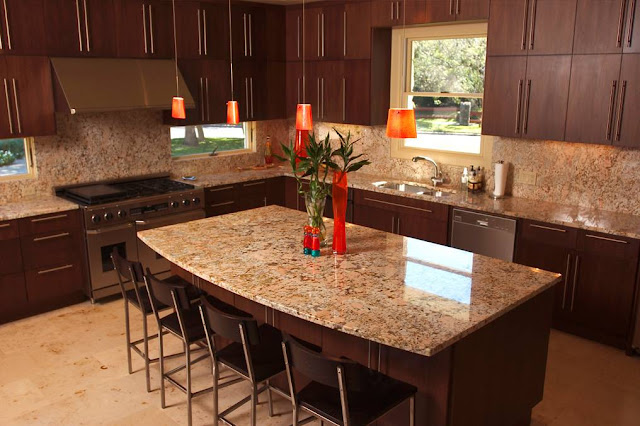
GRANITE

Pro: Not as porous as marble.
It can
generally delay to hot pots and pans and won’t stain as easily as marble.
Generally, granite is not expensive as
marble or quartz.
The nicer stuff
really is often beautiful.
Cons: It seems many folks are over
granite; the less costly stuff was employed by every home builder within the
country and folk are just plain tired of it. Nothing dates a kitchen sort of a
nice dark green Ubatuba countertop.
You should seal it every 6-12 months. (Chill, it’s not plenty of labor. Spray the counters with a sealant, allow them to dry for a couple of hours; wipe off…voila!)
QUARTZ

The most
misunderstood of all of them, I believe)
Here’s the
deal. Quartz (as we all
know it to be classified as a countertop material) may be a man-made stone.
Sure, it's going to have quartz, the gem, that's present, but probably not
plenty of it. It does have many polymers, resins and crushed up other stuff
like granite, maybe even glass and mirrors, etc. that are bound together to
supply Quartz countertops.
It is often
confused with Quartzite - which may be a natural stone, with amazing veining
and similar characteristics as marble.
Pros: Never-ever-ever need to worry about
sealing them, rendering them virtually maintenance-free!
Cons: Is often EX-PEN-SIVE. Plain or
speckly quartz? Probably not so bad. Trying to find dramatic veining or
trending color of the moment? You’ll need to reconsider your budget.
They can etch
burn and/or actually crack if you place your hot turkey roasting pan directly
on the surface. Okay, so I’ve never actually heard of anyone cracking their
quartz counters, but that doesn’t mean it hasn’t happened.
A cautionary word: Some quartz slabs are book-matched;
others aren’t. Book matching may be a process where two adjacent slabs are
mirrored (or book matched) therefore the veining is continuous. What does that
mean for you? If you've got an excellent Long Island or countertop run, it'll
be VERY difficult to make continuous veining if the slabs aren't book matched.
To not say it’s impossible, but it'll be very difficult, and will not be left
to the amateur fabricator.
Read out
complete blog at: https://www.astrumgranite.com/complete-guide-caring-quartz-worktops/


Its a very wonderful post thank you for sharing this post !Data recovery in chennai
ReplyDelete